

When it comes to medicinal plants, it is worth noting the importance of the multi-volume scientific encyclopedic work by Hero-Arkadag “Medicinal Plants of Turkmenistan”, which is of great interest to scientists, health workers, pharmacists, collectors and all people involved in the study of the plant world. The valuable scientific data presented in this fundamental work contribute to the enrichment of knowledge about medicinal plants, the external structure of plants, their growth conditions, chemical composition, use in medicine, as well as seasons and methods of their collection, and storage rules.
In the Epoch of the Revival of the New Era of the Powerful State, thanks to the attention paid to the development of this direction by the Hero-Arkadag, and Arkadagly Hero Serdar, in the Scientific and Production Center for Horse Breeding of the State Association "Türkmen atlary" in Arkadag city, equipped with modern high-tech equipment, in order to improve the horse breeding industry and increase the number of purebred racehorses, broad opportunities have been created for preserving the breeding purity of Ahalteke horses, the succession of their offspring, as well as the scientific study of the rules of breeding, care and feeding.
Today, scientific research is being conducted in global practice to study the properties of various medicinal plants and their impact on strengthening the health of horses, preventing diseases, increasing their immunity, as well as fighting viruses, bacteria and fungi. For example, information about the effect of a number of medicinal plants on horses is described in the book by E. Robinson. (E. Robinson. Diseases of foals. Modern methods of treatment: translated from English / E. Robinson. Moscow: Aquarium-Print, 2007). In addition, interesting information about the medicinal plant - rose hips is described in detail in the book by N. Laman. (Nikolai Laman, Natalia Kopylova. Rose hips - a natural concentrate of vitamins and antioxidants - Minsk, 2017.) There is also information that it is useful to give animals 50 grams of crushed rose hips daily. [OOO "BIOTEKH-S" - manufacturer of medicinal herbal preparations and electronic supplements. resource. Access mode: http://koni-travi.ru/information/]
Rose hips contain phenolic compounds, carotenoids, ascorbic acid, fats, linoleic acid, phytosterols, sitosterol and other useful substances. For example, there is evidence that the polyphenols of this plant have an antioxidant effect on animals. (I.Paular, Analysis of the existing research regarding the use of the species rosa canina., 2020). The biological value of preparations made from the fruits of the medicinal plant – rose hips, and waste-free production technologies of medicinal supplements have also been studied. (H.Kilicgun, A.Dehen, In vitro Antioxidant Effect of Rosa canina in Different Antioxidant Test Systems. Pharmacongnosy Research, 2009.)
It is known that bryony (Bryony dioica) is widely used against tumors, treatment of joint diseases and digestive organs of animals. This plant has a beneficial effect on the excretory, respiratory, cardiovascular and immune systems of animals, and also helps regulate body functions. In addition, there is evidence that bryony has an exogenous effect on horses, that is, against skin parasites. (Asadova Shalola Ilkhomovna, Medicinal properties of the plant Bryonia dioica, bryony. 2018).
The root of bryony (bryony dioica) (lat. Radix Bryoniae albae recens) is mainly used as a medicinal raw material. From the freshly collected roots of this plant, a medicine called "Acophyte" is prepared, which is mainly used to treat rheumatism, colic, edema and other diseases. (Pohlmann J., Die Cucurbitacine in Bryonia alba und Bryonia dioica. Phytochem., 1975; 14(7): 1587-1589). Based on the data of the multivolume scientific encyclopedic work by Hero-Arkadag "Medicinal Plants of Turkmenistan" in the Scientific and Production Center of Horse Breeding of the State Association "Türkmen atlary" for the purpose of scientifically studying the influence of medicinal plants, in particular, rose hips (Rosa canina) and bryony (Bryonia dioica) to enrich the feed base of horses, strengthen their health, prevent diseases, increase immunity, scientific research is being conducted on the topic: "Medicinal plants that affect the immunity of horses."
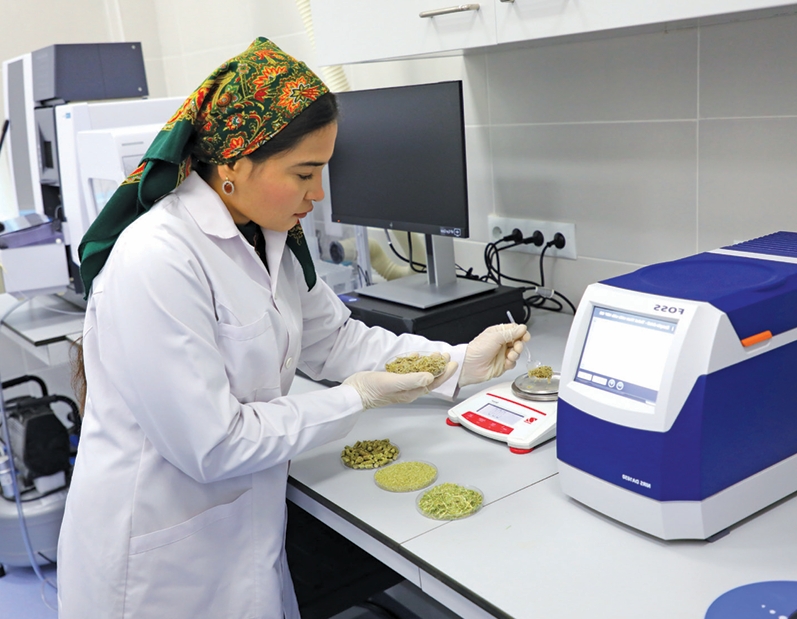
During the scientific research, the Center's specialists determined the nutritional value of rose hips and bryony using the Foss Nirs device (Denmark, NIRSTM DA1650). For this purpose, 30-gram granules were prepared from the above-mentioned dried medicinal plants during the work and analyzed using the Foss Nirs device. As a result of the conducted research, it was established that the composition of rose hips consists of fats - 2.52%, protein - 8.49%, starch - 14.2%, and the composition of bryony contains fat - 1.2%, protein - 23.87% and starch - 36.6%. Based on this, a more in-depth scientific study of the influence of medicinal plants – rose hipsand bryony – on horses, as well as their pharmaceutical properties, is planned.
Rosehip (Rosa canina) is a shrub plant that is found mainly in the valleys, on the slopes and along the springs of Kopetdag. Rosehip belongs to the rose family, its height reaches 1.5-2.0 meters, and is one of the wild plants. The fruits of the medicinal plant - rose hips, as a rule, have an ovoid, round or spherical shape, their length is 1-2 cm. When ripe, the fruit is orange-red or coral in color. The weight of the fruit is 1.7-3.2 grams. It blooms in May-June, bears fruit in July-September. Rose hips are rich in vitamins. Their fruits contain: vitamins B, K, P and others, carotene, sugar, alkaline substances, various microelements, and their seeds contain vitamin E. That is why rose hips are also called a "storehouse of vitamins". Rose hips contain a large amount of vitamin C (ascorbic acid). This vitamin affects blood pressure and regulation of metabolism. Flavonoids contained in the medicinal plant are of great importance in protecting the body from diseases. They have a beneficial effect on blood circulation and normalization of heart function.
Bryonia dioica is a perennial plant belonging to the pumpkin family. Its root consists of two parts. The plant has been popular among Turkmens since ancient times. This is evidenced by the folk wisdom associated with this plant: "A horse that has tasted bryony will not die." In our country, this plant is found in the Southern and Western Kopetdag: in such areas as Nokhur, Sayvan, Desht Kenegumme, Aydere, Parkhai, Bogundar, Sunt, Akkaya; in the Central Kopetdag these are: Archabil, Gokdere, Sarymsak, Syulyuk, Mergenyoland, Kheyrabat, Garanky, Khovdan. Bryony grows well in damp and shady places. It blooms in May-August. The root of the plant is mainly used for medicinal purposes. The root of the bryony contains amorphous glycosides, bryonin, briogenin, glucose, starch, urea, malic acid salts and other substances. This plant is known for its antiulcer, analgesic, sedative, diuretic and hematopoietic effects.
The ancient breed of Ahalteke horses was created on Turkmen soil based on folk selection over the course of thousands of years. Significant work is being carried out in Turkmenistan to popularize Ahalteke horses, which are the standard of beauty and perfection, at the global level. Ahalteke horses, whose history goes back thousands of years and are known for their beauty, activity and thoroughbredness, are one of the national treasures. "Heavenly" horses, which are a national pride, have a sensitive nature and have been considered man's faithful friends since time immemorial. Careful preservation of the unique cultural heritage of the Turkmen people and the popularization of its values in the world contributes to the development of priority areas of the country's state strategy and the advancement of the national horse breeding industry to new frontiers.
Gulshat MEREDOVA,
Chief Researcher Scientific and Production
Center for Horse Breeding of the
"Türkmen atlary" State Association
(from the pages of the magazine “Heavenly Ahalteke Horses” No. 1(27)2025)