

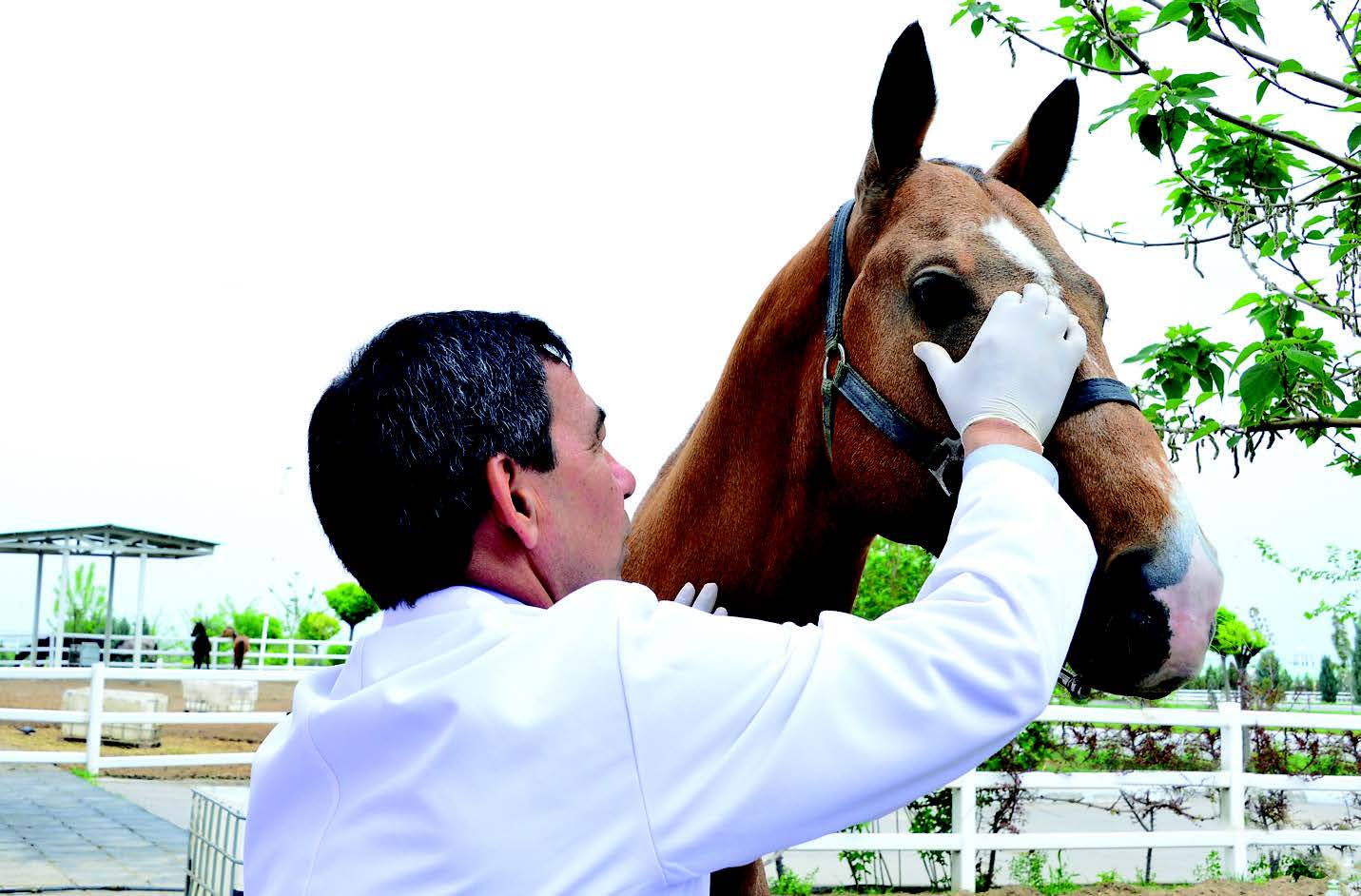
Akhalteke horses are the direct descendants of horses bred on the territory of modern Turkmenistan approximately 5,000 years ago, and the Turkmen people have accumulated a rich experience in horse training and breeding (seyislyk), creating this world-famous breed. When working with horses, it is absolutely essential to take their biological characteristics into account, and one of the most important among them is their extraordinarily high visual perception.
Horses are capable of seeing surrounding objects panoramically with a field of view of up to 360°, while in humans this figure is about 200°. They see objects located ahead at a distance of up to 4 meters directly in front of them with both eyes, but they look at objects located closer than this distance by turning their head in the appropriate direction and using the eye on that same side.
In order to study the ability of horses to distinguish colors, scientists used various research methods, which revealed that they easily distinguish multicolored shapes, see the difference between white and black, and can effortlessly separate red and blue colors from gray. At the same time, it is more difficult for horses to distinguish green and yellow colors because, according to scientists, the animals' color perception of these shades is considered similar to color blindness.
The ability of horses to see perfectly at night arouses great interest among specialists, as modern scientific data show that there is a much larger number of cells responsible for vision in the dark within the inner layer of their eyes. In addition, a horse's eyes feature a special "mirror-like" vascular layer consisting of reflective particles, which captures and reflects passing light, significantly increasing visual acuity in the dark. On the whole, it can be said that horses see much better than humans, and this is proven by their confident movements at night when they easily overcome any obstacles.
Horses successfully pass through barriers and unfamiliar areas, stop before difficult obstacles, and accurately calculate all their movements thanks to a superbly developed sense of visual estimation. The famous scientist, Professor Timney, proved this experimentally using visual illusion images, and during the second stage of the research, he confirmed that horses can excellently distinguish spatial shapes, scientifically proving the high accuracy of their visual judgment. When attending horse races and equestrian sports events, spectators often notice small eye covers on the horses' heads, which causes a sense of surprise for those visiting such events for the first time. The primary reason for using these special blinders is to prevent them from being distracted by external sounds and movements, since horses are naturally timid by their nature and can perform unpredictable wrong movements during competitions. For those purposes, horse owners and trainers put a special headgear on the horse's head and use eye covers that prevent the horse from seeing both sides.
Thus, due to the unique structure of the horse's eye, they can see in the dark, distinguish certain colors, and move confidently in unfamiliar places, being capable of perceiving their surroundings in the form of three-dimensional images and distinguishing familiar and necessary things from among them.
Rahman Аbaev
Source: Abstracts of reports of the XIV Scientific Conference “Turkmen horse and horse breeding art of the world” April 22, 2022